Protection
Provide flexible, subcycle, low-impedance bus differential protection for various busbar topologies and sizes with the SEL-487B. You can protect systems that have up to 21 three-phase bus terminals by using three relays to provide 6 three-phase differential bus zones and 3 independent check zones. To optimize protection security, the check zones supervise the system on a per-phase basis and a patented open-CT detection algorithm blocks potential misoperations during open- or shorted-CT conditions. Directional and low-impedance differential current elements provide increased security and fast fault detection. Built-in breaker failure protection reduces protection costs. Flexibility
Apply the same CT for differential protection, metering, backup relaying, or other functions. The SEL-487B can use nondedicated CTs with ratio mismatches up to 35:1. Automation and Control
Reduce project costs and simplify interconnect wiring using multiple communications protocols. Configurable operator controls and simplified variable naming provide added power to SELogic control equations. Monitoring and Metering
Provide accurate, timely monitoring and metering of busbar, feeder, and substation signals. Terminal currents, breaker and disconnect positions, station dc power levels, and three-phase voltage are continuously monitored and updated. You can eliminate external recorder and metering requirements with oscillographic and binary COMTRADE event reports and Sequential Events Recorder (SER) reporting. Three Independent Check Zones
Improve power system availability and reliability by reducing unintentional relay operations due to failed or misaligned disconnect auxiliary contacts, and provide redundant verification of in-zone faults. Independent check zone settings offer additional flexibility for adjusting the check zone differential element. Advanced Open CT Detection
Improve the security of the current differential element with patented open CT detection logic. It assures current differential bus zones will not misoperate due to terminals that can’t be properly measured. Enhanced Front-Panel HMI
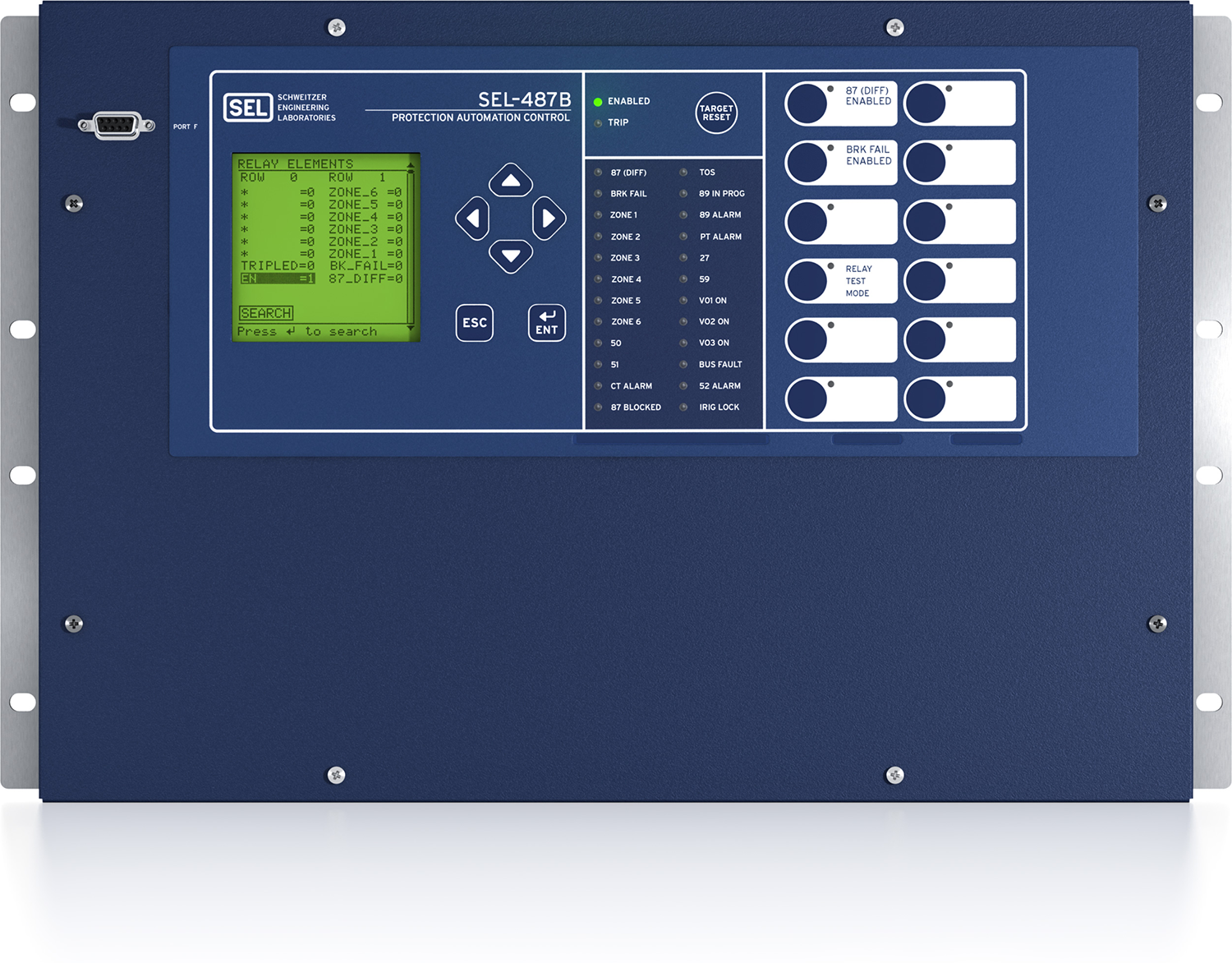
Improve efficiency and simplify installation with more target LEDs and operator pushbuttons. The 7U and 9U chassis have options for an additional 8 target LEDs and 4 operator pushbuttons, providing 24 target LEDs and 12 operator pushbuttons on the front-panel HMI. SEL TiDL-Based Solutions
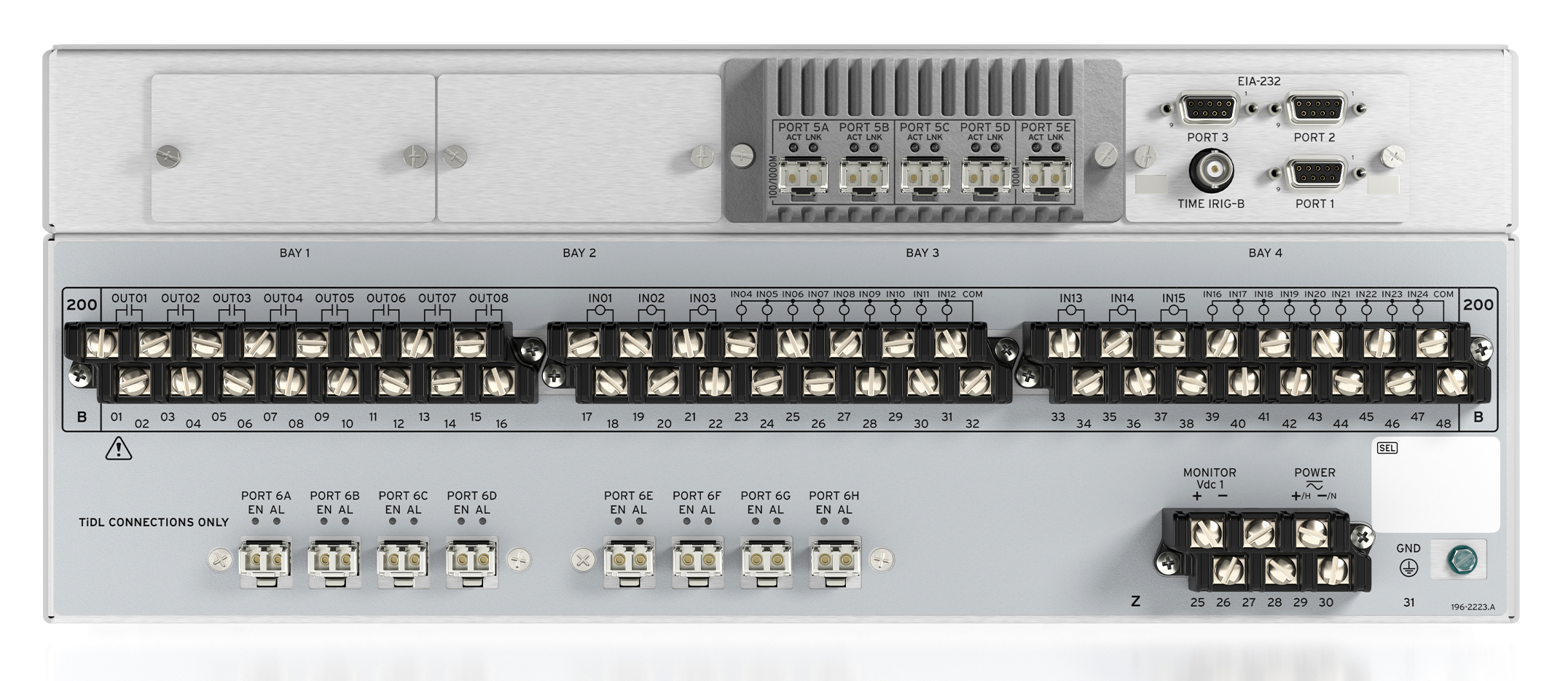
Apply a TiDL-based process bus solution, where SEL-TMU devices are placed in the yard close to the primary equipment to digitize discrete I/O signals and analog data. SEL-TMU units exchange these data with an SEL-487B-2 TiDL relay in the control house. Each SEL-TMU can share data with as many as four TiDL relays, providing protection design flexibility. TiDL combines the proven protection of the SEL-400 series relays with the purpose-built SEL-TMU, simplifying deployment, reducing training requirements, and increasing availability. TiDL technology uses point-to-point connections and a non-Ethernet protocol, providing a simple and secure solution. TiDL also provides built-in data synchronization and synchronous sampling, ensuring protection is available in the relay regardless of whether an external time signal is available. SEL SV-Based Solutions
Based on the IEC standards, SV-based solutions maximize flexibility and interoperability. The SEL-401 Protection, Automation, and Control Merging Unit and the SEL-421-7 Protection, Automation, and Control System Merging Unit digitize analog signals from primary equipment and send them using the SV protocol to an SEL-487B-2 relay in the control house. Because all SEL SV devices are compliant with IEC 61850-9-2 and the UCA 61850-9-2LE guideline as well as IEC 61869-9, the SEL-487B-2 SV relay can be used with other manufacturers’ compliant units. Flexible Ethernet Communications
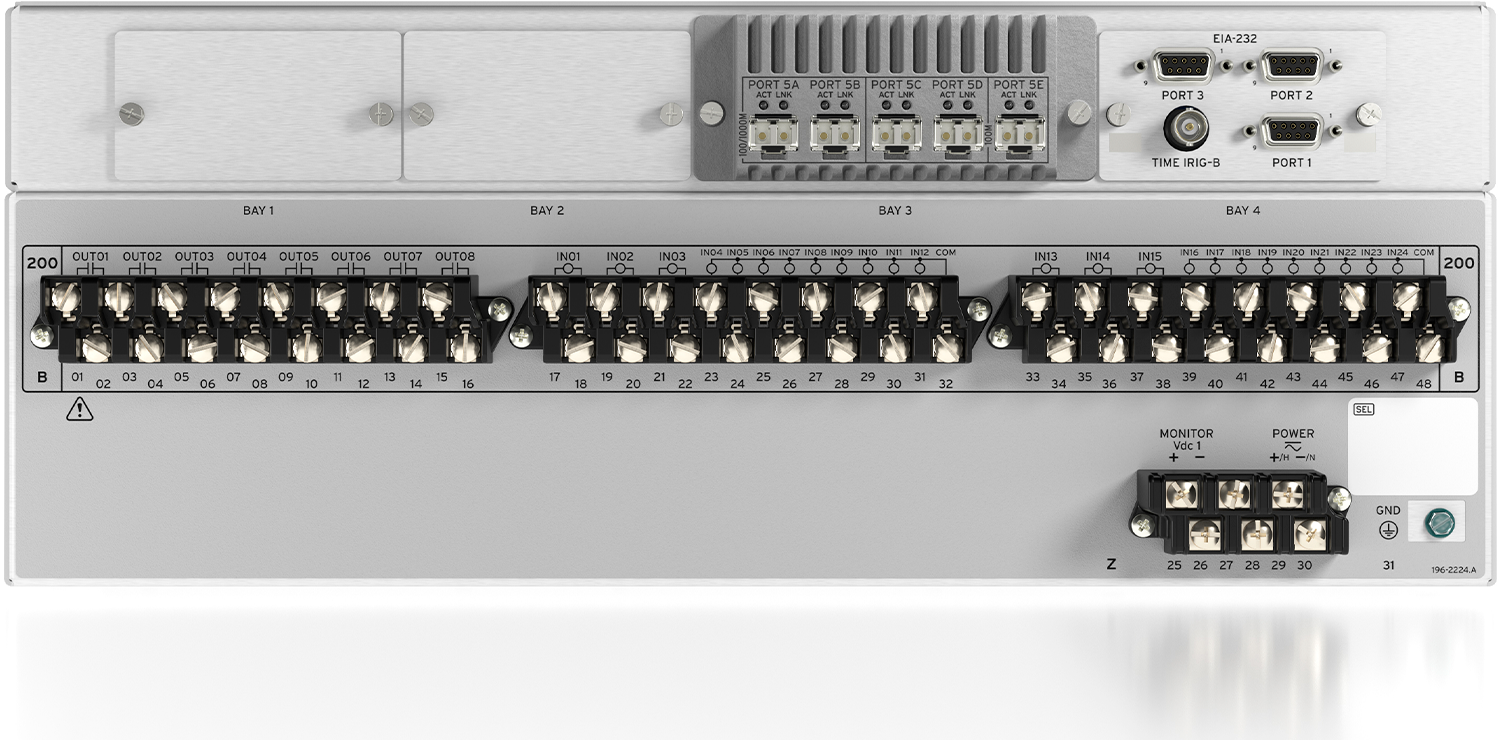
The two-, four-, and five-port Ethernet communications card options enable you to communicate using a variety of protocols, including FTP, HTTP, DNP3, PTPv2, PRP, Telnet, synchrophasors, and IEC 61850 Edition 2.1. The TiDL and SV relays can be configured with a five-port Ethernet card supporting PRP, HSR, or failover functionality to increase system availability, as well as PTPv2 on process bus or station bus ports for time synchronization. Use network monitoring features in the relay to further improve system availability by actively monitoring each redundant path to detect communications network failures. The five-port card also features dedicated ports and IP addresses for station bus and engineering access networks to provide selective access control. All ports support SFP transceivers. Single- and multi-mode communications options provide increased flexibility. All ports support 100 Mbps SFP transceivers, and process bus ports also support 1 Gbps SFP transceivers. Serial Communications
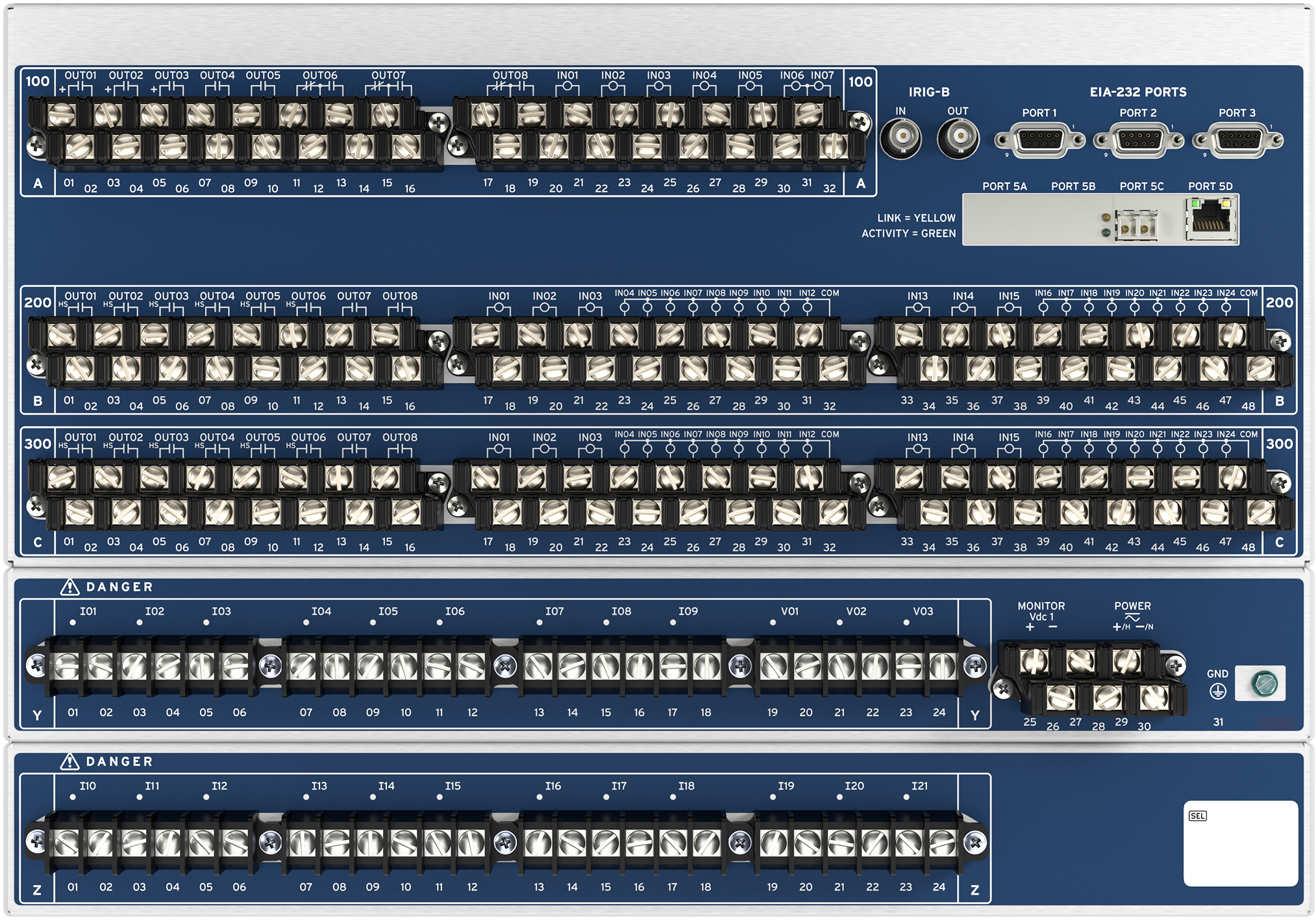
All four independent EIA-232 serial ports support SEL Fast Message, SEL ASCII, Compressed ASCII, SEL Fast Operate, SEL Fast Meter, SEL Fast SER, enhanced SEL Mirrored Bits communications, and DNP3 Level 2 Outstation as well as dial-out, Virtual Terminal, and communications with SEL-2600 series RTD modules. Simplified Settings Management
Use acSELerator QuickSet SEL-5030 Software to develop relay settings offline and program SELogic control equations. Configure the TiDL and SV relays using SEL Grid Configurator, a software tool that increases efficiency and improves settings insights. It features a spreadsheet-style editor, protection visualization, comprehensive reporting, custom filters, and multiple-device settings management.