SEL-T401L

SEL-T401L

Ultra-High-Speed Line Relay

The SEL-T401L is a high-performance, easy-to-use line protective relay in a 3U package. Built on the field experience of the SEL-T400L Time-Domain Line Protection, the SEL-T401L delivers unprecedented operating times and includes the complete suite of primary and backup protection functions that you expect in a line protection system. Suitable for a wide range of applications, the SEL-T401L offers an opportunity to reset the complexity of line protection applications with its simple protection philosophies, and reduced settings count. You can apply the SEL-T401L on its own or as part of a redundant protection system with other SEL relays without concerns for common-mode failures. The new technology of traveling waves and incremental quantities along with the enhancements and simplifications in phasor-based protection elements make the SEL-T401L protection philosophy, hardware, and software different from other SEL line protective relays. You’ll gain efficiency by using common SEL configuration and integration tools and also benefit from strong diversity in hardware, software, and protection operating principles.

Starting at

$20,500

Ultra-High-Speed Protection

The SEL-T401L offers the complete suite of protection functions that you expect in a line protection system. Protect your lines by using the SEL-T401L ultra-high-speed elements and schemes based on the field-proven SEL time-domain technology of traveling waves and incremental quantities with demonstrated operating times on the order of 1–5 ms. The SEL-T401L includes high-performance distance protection with five zones of phase and ground elements, individually selectable as either mho or quadrilateral, with subcycle operating times. The SEL-T401L also includes dependable protection and supervisory functions, including sensitive directional, switch-onto-fault, overcurrent, over- and undervoltage, load encroachment, out-of-step tripping, and power-swing blocking.

Unparalleled Fault Locating

The SEL-T401L includes single- and double-ended traveling-wave-based fault-locating methods that are accurate to within a single tower span. It also includes single- and double-ended impedance-based methods. The combination of single-ended and double-ended methods, as well as traveling-wave-based and impedance-based methods, provides the best accuracy and dependability for any combination of operating conditions and fault types. Combining the SEL-T401L high-speed double-ended traveling-wave-based fault-locating technology and built-in adaptive location-dependent autoreclose cancel logic allows selective reclosing on the overhead portion of hybrid lines and inhibits reclosing on cable portions. The SEL-T401L also includes a line monitor function, which can be used for condition-based line maintenance to prevent line faults and to discover weak spots along the line.

Simplicity

Reset the complexity of your line protection applications with the simple and robust protection philosophies and considerably lower settings count of the SEL-T401L. The SEL-T401L design achieves the right balance between flexibility and simplicity. We have streamlined, named, grouped, and presented the relay settings with great care for intuitive application and ease of use. Apply the relay with preconfigured logic, or adjust the factory defaults with SELogic equations using gates, timers, and latches.

Ultra-High-Resolution Transient Recording

The SEL-T401L measures and records line currents and voltages with high-fidelity (1 MHz, 18-bit) sampling, offering an enhanced understanding of the events on your power system. This allows you to analyze high-frequency transients, such as traveling waves from faults, switching events, breaker restrikes, and self-extinguishing faults.

SEL-T401L Features
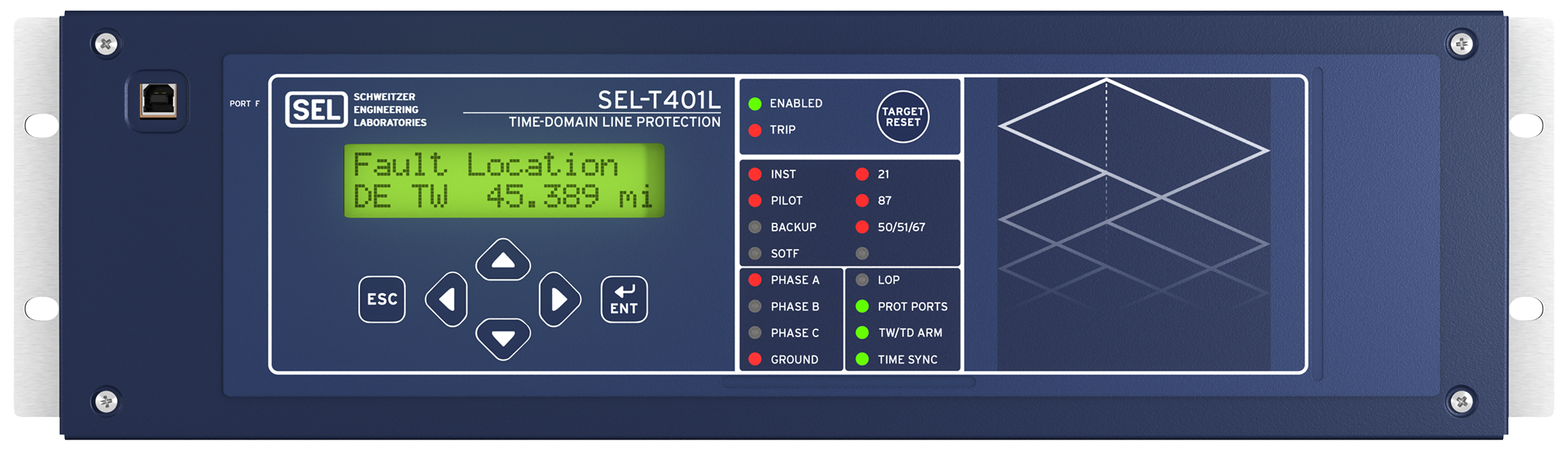
T401L_Front.png
1
2
3
4
5
  1. USB 2.0 port for local engineering access
  2. Display for viewing metering, event, fault location, and relay status information
  3. Simple HMI navigation
  4. Slide-in label pocket and LED targets for viewing trip cause, fault type, and basic relay status
  5. Large slide-in label pocket for diagrams or asset information
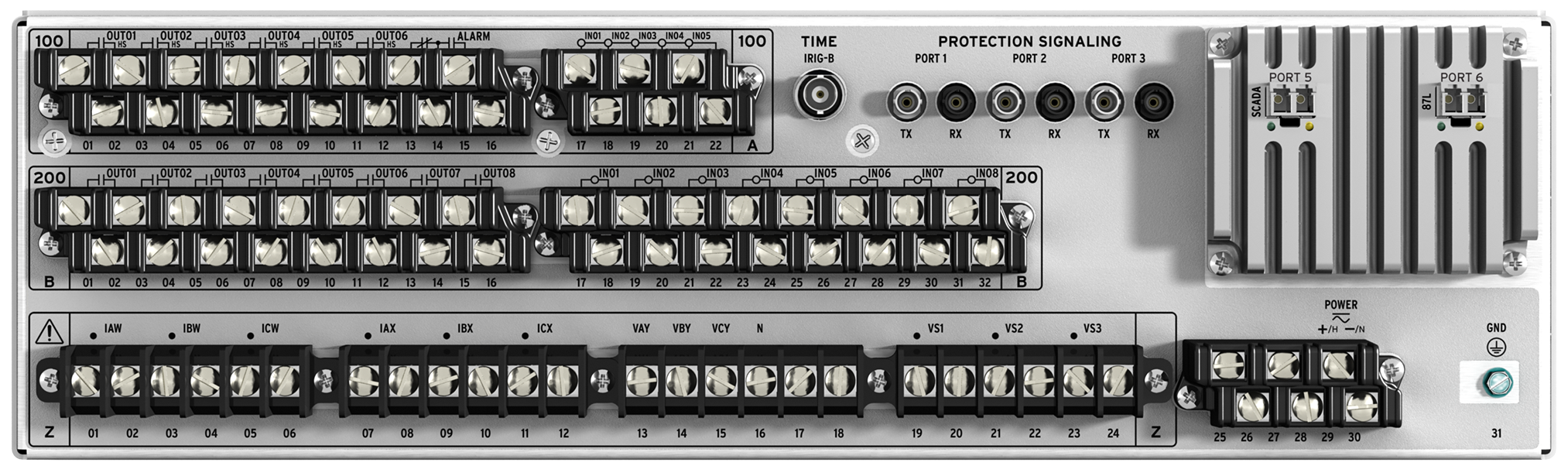
T401L_Back.png
1
2
3
4
5
6
7
8
9
10
11
12
13
  1. Six trip-rated high-speed outputs for single-pole tripping of two breakers
  2. Alarm output
  3. Five inputs with a common terminal
  4. IRIG-B time input
  5. Three fiber-optic ports for multiplexed or direct protection signaling (SEL MB8 or IEEE C37.94)
  6. 100 Mbps or 1 Gbps small form-factor pluggable (SFP) Ethernet port for engineering access and SCADA
  7. SFP fiber-optic port for ultra-high-bandwidth protection signaling over direct fiber
  8. Eight outputs for POTT, DCB, DTT, breaker failure initiation (BFI), and other signaling
  9. Eight inputs for POTT, DCB, DTT, triggering, and other signaling
  10. Breaker 1 and 2 current inputs
  11. Line voltage
  12. Auxiliary voltage (metering and digital fault recorder)
  13. Power supply

SEL-T401L Details

Time-Domain Line Protection. Protect transmission lines with ultra-high-speed elements and schemes based on the field-proven SEL time-domain technology of traveling waves and incremental quantities. Clear close-in high-current faults in 2 ms with the underreaching incremental-quantity distance protection element (TD21) without relying on a protection channel. Dependably protect the entire line with permissive overreaching transfer trip logic over a standard digital or analog protection channel with traveling-wave (TW32) and incremental-quantity (TD32) directional elements operating as fast as 0.1 ms and 1.5 ms, respectively. Achieve both extraordinary speed and sensitivity with the traveling-wave differential protection scheme (TW87) over a direct fiber-optic channel with end-to-end operating times of 1 to 5 ms, depending on the line length. Dependable Protection. Complement and back up the traveling-wave and incremental-quantity protection elements and schemes with distance elements, dependable and sensitive directional elements, overcurrent elements, switch-onto-fault logic, permissive and blocking pilot logic, open-breaker echo logic, and weak-infeed logic. Provide remote backup and coordinate with adjacent relays by using step distance protection, definite- and inverse-time overcurrent elements, and definite-time over- and undervoltage elements. Advanced Distance Elements. Apply five zones of distance protection for direct tripping, in the pilot protection logic, in the switch-onto-fault logic, and for step distance protection. Satisfy your distance protection philosophy and coordinate with adjacent relays by selecting the operating characteristic as either mho or quadrilateral (on a per-zone basis, independently for the phase and ground distance elements). Use the nondirectional (offset) Zone 5 distance element in the switch-onto-fault logic, for time-coordinated backup protection for local bus faults, and for nondirectional starting of the blocking pilot scheme. Supervisory Elements. Improve protection performance with open-pole detection, loss-of-potential, load encroachment, and power-swing blocking logic. Perform system operation during unstable power swings by using the out-of-step tripping logic. Flexible Protection Signaling. Send and receive permissive and blocking signals, direct trip signals, autoreclose initiate signals, and breaker failure initiate signals over contact I/O and over as many as three fiber-optic protection ports. When using a digital channel for protection signaling, select—on a per-port basis—either SEL MB8 encoding or IEEE C37.94 encoding. To simplify and standardize protection panel wiring and improve signal integrity, use the SEL-2507 High-Speed Remote I/O Module to connect to your analog teleprotection channel interface with a fiber-optic cable. Comprehensive Applications. Protect two-terminal and multiterminal lines with single- or dual-breaker terminations in single- or three-pole tripping applications. Protect and accurately locate faults on series-compensated lines, overhead and cable lines, as well as hybrid lines with both overhead and cable sections. Trip-Rated Outputs. Eliminate interposing relays and trip directly with high-speed trip-rated relay outputs to simplify wiring, increase reliability, and improve trip times. Trip one or two breakers directly with as many as six outputs in single-pole or three-pole tripping applications. Modern Relay for a Modern Power System. Confidently protect lines near nonstandard generators, such as wind generators or inverter-based sources; in low-inertia systems with HVdc links; and in systems with series compensation. The SEL-T401L traveling-wave and incremental-quantity protection elements and schemes are well suited for modern power systems with such characteristics. The relay also features several enhancements in areas such as sensitive directional elements, memory polarization, and use of sequence components in general to address these emerging power system characteristics.Accurate Fault Locating. Locate faults to the nearest tower with the field-proven SEL traveling-wave-based fault-locating technology. Obtain a reliable fault location with the double-ended traveling-wave-based fault-locating method by using a 64 kbps digital channel with IEEE C37.94 encoding or a direct fiber-optic channel. In applications without a digital protection channel, use the single-ended traveling-wave-based fault-locating method and obtain a short prioritized list of possible fault locations. Ensure dependable fault locating under a wide range of operating conditions with the double-ended and single-ended impedance-based fault-locating methods. Use standard cabling to wire the SEL-T401L to standard protection instrument transformers. Location-Dependent Autoreclosing Control. Allow or inhibit autoreclosing based on the accurate real-time fault location. Inhibit reclosing for faults on the cable sections of a hybrid line, near airports, along fire-prone stretches of an overhead line, or in areas where humans or animals are present. Location-dependent autoreclosing control works over a direct fiber-optic channel or a 64 kbps IEEE C37.94-encoded multiplexed channel. Line Monitoring. Monitor the line for incipient faults, recurring faults, or incipient cable faults. Obtain a location-tabulated event count to detect low-energy activity and faults along the line. Prevent faults by selectively cleaning or replacing insulators, trimming vegetation, improving antigalloping solutions, applying line spacers, or improving lightning protection. Line monitoring works over a direct fiber-optic channel or a 64 kbps IEEE C37.94-encoded multiplexed channel.Ultra-High-Resolution Transient Recording. Record as many as six currents and six voltages at a 1 MHz sampling rate with 18 bits of resolution. Store no less than 45 s of total recording time before having to retrieve the records. Use a direct fiber-optic channel to record line currents and voltages at the remote line terminal or to deploy a two-chassis recording system with a total of 24 channels. Study switching events and other high-frequency phenomena in a single substation or throughout the system by deploying a multichassis recording system with 100 ns accuracy time synchronization between multiple SEL-T401L relays. Use the low burden, dc-coupled SEL-T401L voltage inputs to connect to high-bandwidth, low-power voltage sensors.

Configuration Software

acSELerator QuickSet SEL-5030 Software

QuickSet is a tool for engineers and technicians to quickly and easily configure, commission, and manage power system devices. QuickSet includes a Graphical Logic Editor and a device template tool to reduce configuration time and streamline deployment. Learn more and download on the QuickSet software page.

Visualization and Analysis

SEL-5601-2 Synchrowave Event Software

Synchrowave Event helps engineers diagnose a protective relay’s behavior during a power system fault. It is a powerful and easy-to-use solution for displaying and analyzing SEL relay event reports and COMTRADE files. Learn more and download on the Synchrowave Event software page.

Use Transient-Based Relays to Solve Line Protection Challenges in Systems With IBRs

Lighting up the Desert Nation

What Are Traveling Waves, and Why Are They Useful?