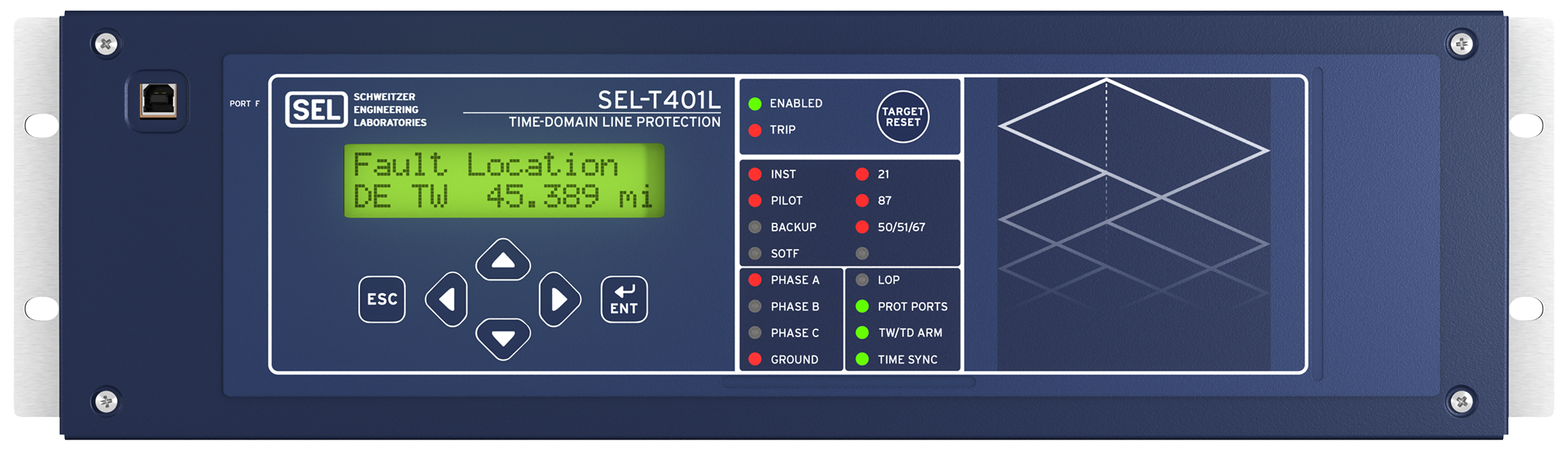
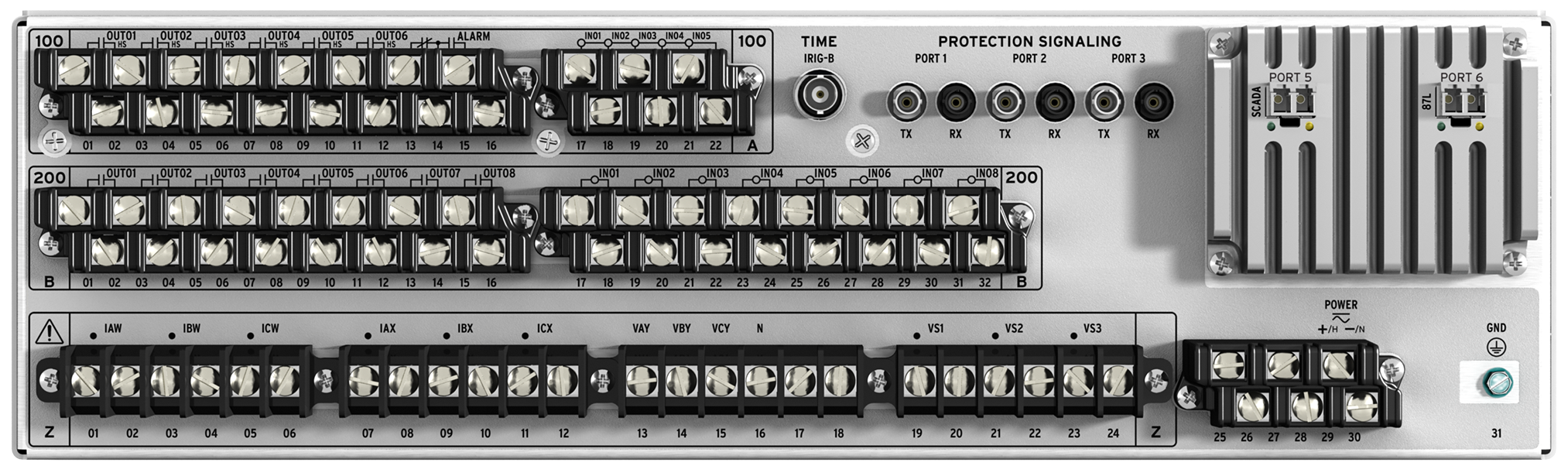
Time-Domain Line Protection. Protect transmission lines with ultra-high-speed elements and schemes based on the field-proven SEL time-domain technology of traveling waves and incremental quantities. Clear close-in high-current faults in 2 ms with the underreaching incremental-quantity distance protection element (TD21) without relying on a protection channel. Dependably protect the entire line with permissive overreaching transfer trip logic over a standard digital or analog protection channel with traveling-wave (TW32) and incremental-quantity (TD32) directional elements operating as fast as 0.1 ms and 1.5 ms, respectively. Achieve both extraordinary speed and sensitivity with the traveling-wave differential protection scheme (TW87) over a direct fiber-optic channel with end-to-end operating times of 1 to 5 ms, depending on the line length. Dependable Protection. Complement and back up the traveling-wave and incremental-quantity protection elements and schemes with distance elements, dependable and sensitive directional elements, overcurrent elements, switch-onto-fault logic, permissive and blocking pilot logic, open-breaker echo logic, and weak-infeed logic. Provide remote backup and coordinate with adjacent relays by using step distance protection, definite- and inverse-time overcurrent elements, and definite-time over- and undervoltage elements. Advanced Distance Elements. Apply five zones of distance protection for direct tripping, in the pilot protection logic, in the switch-onto-fault logic, and for step distance protection. Satisfy your distance protection philosophy and coordinate with adjacent relays by selecting the operating characteristic as either mho or quadrilateral (on a per-zone basis, independently for the phase and ground distance elements). Use the nondirectional (offset) Zone 5 distance element in the switch-onto-fault logic, for time-coordinated backup protection for local bus faults, and for nondirectional starting of the blocking pilot scheme. Supervisory Elements. Improve protection performance with open-pole detection, loss-of-potential, load encroachment, and power-swing blocking logic. Perform system operation during unstable power swings by using the out-of-step tripping logic. Flexible Protection Signaling. Send and receive permissive and blocking signals, direct trip signals, autoreclose initiate signals, and breaker failure initiate signals over contact I/O and over as many as three fiber-optic protection ports. When using a digital channel for protection signaling, select—on a per-port basis—either SEL MB8 encoding or IEEE C37.94 encoding. To simplify and standardize protection panel wiring and improve signal integrity, use the SEL-2507 High-Speed Remote I/O Module to connect to your analog teleprotection channel interface with a fiber-optic cable. Comprehensive Applications. Protect two-terminal and multiterminal lines with single- or dual-breaker terminations in single- or three-pole tripping applications. Protect and accurately locate faults on series-compensated lines, overhead and cable lines, as well as hybrid lines with both overhead and cable sections. Trip-Rated Outputs. Eliminate interposing relays and trip directly with high-speed trip-rated relay outputs to simplify wiring, increase reliability, and improve trip times. Trip one or two breakers directly with as many as six outputs in single-pole or three-pole tripping applications. Modern Relay for a Modern Power System. Confidently protect lines near nonstandard generators, such as wind generators or inverter-based sources; in low-inertia systems with HVdc links; and in systems with series compensation. The SEL-T401L traveling-wave and incremental-quantity protection elements and schemes are well suited for modern power systems with such characteristics. The relay also features several enhancements in areas such as sensitive directional elements, memory polarization, and use of sequence components in general to address these emerging power system characteristics.Accurate Fault Locating. Locate faults to the nearest tower with the field-proven SEL traveling-wave-based fault-locating technology. Obtain a reliable fault location with the double-ended traveling-wave-based fault-locating method by using a 64 kbps digital channel with IEEE C37.94 encoding or a direct fiber-optic channel. In applications without a digital protection channel, use the single-ended traveling-wave-based fault-locating method and obtain a short prioritized list of possible fault locations. Ensure dependable fault locating under a wide range of operating conditions with the double-ended and single-ended impedance-based fault-locating methods. Use standard cabling to wire the SEL-T401L to standard protection instrument transformers. Location-Dependent Autoreclosing Control. Allow or inhibit autoreclosing based on the accurate real-time fault location. Inhibit reclosing for faults on the cable sections of a hybrid line, near airports, along fire-prone stretches of an overhead line, or in areas where humans or animals are present. Location-dependent autoreclosing control works over a direct fiber-optic channel or a 64 kbps IEEE C37.94-encoded multiplexed channel. Line Monitoring. Monitor the line for incipient faults, recurring faults, or incipient cable faults. Obtain a location-tabulated event count to detect low-energy activity and faults along the line. Prevent faults by selectively cleaning or replacing insulators, trimming vegetation, improving antigalloping solutions, applying line spacers, or improving lightning protection. Line monitoring works over a direct fiber-optic channel or a 64 kbps IEEE C37.94-encoded multiplexed channel.Ultra-High-Resolution Transient Recording. Record as many as six currents and six voltages at a 1 MHz sampling rate with 18 bits of resolution. Store no less than 45 s of total recording time before having to retrieve the records. Use a direct fiber-optic channel to record line currents and voltages at the remote line terminal or to deploy a two-chassis recording system with a total of 24 channels. Study switching events and other high-frequency phenomena in a single substation or throughout the system by deploying a multichassis recording system with 100 ns accuracy time synchronization between multiple SEL-T401L relays. Use the low burden, dc-coupled SEL-T401L voltage inputs to connect to high-bandwidth, low-power voltage sensors.